By the Pawy Editorial Team. This guide is educational and is not veterinary or behavioural advice. If you have concerns about your dog's health or behaviour, please speak with a veterinarian or qualified behaviourist.
Indoor dog enrichment means giving your dog structured ways to use natural behaviours — sniffing, licking, chasing, chewing and problem-solving — inside your home. You don't need a big backyard, expensive equipment or hours of spare time. Most enrichment activities take one or two minutes to set up and use food your dog was going to eat anyway. This guide covers what enrichment actually is, the five core activity types, how to choose the right difficulty, and a realistic first week.
What dog enrichment actually means
Dogs evolved to work for food. A wild canid spends a large part of its day searching, tracking, sniffing and manipulating things to eat. A modern indoor dog gets the same food in thirty seconds from a bowl — and all of that searching instinct has nowhere to go. Enrichment simply redirects normal feeding into activities that engage those instincts.
That's the whole idea. Enrichment is not a treatment for behavioural or medical problems, and it does not replace exercise, training, companionship or professional care. It is one useful part of an ordinary dog's routine — particularly on busy workdays and rainy weeks when outdoor time is limited.
The five core activity types
1. Rolling
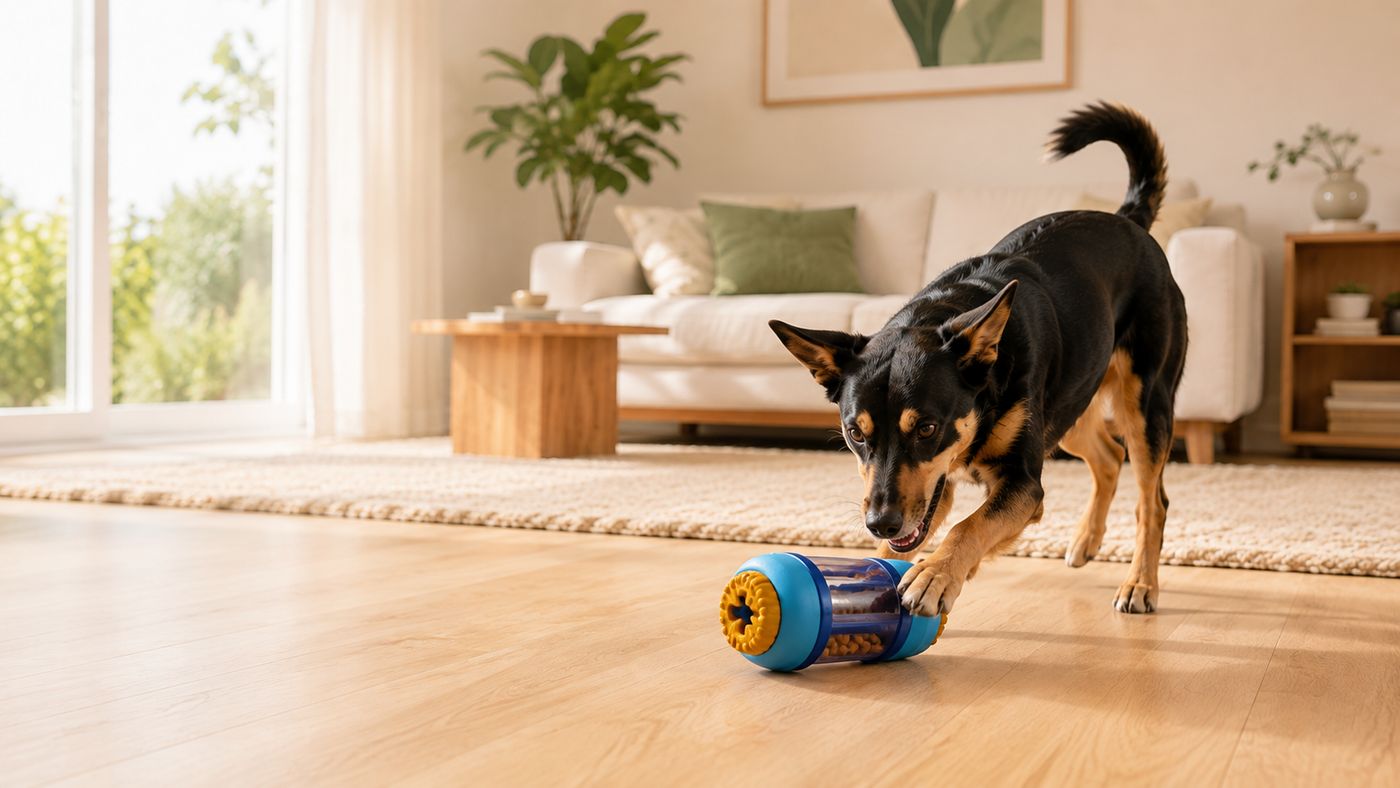
Treat-dispensing toys release food as your dog nudges and follows them. The reward is immediate and the link between action and food is obvious, which makes rolling toys the easiest entry point for most dogs. See the Workday Wobble treat dispenser and the Treat Trail rolling treat ball, or browse all puzzle feeders.
2. Licking
Textured mats hold soft food that your dog works at slowly with their tongue. Licking sessions are quiet and stationary, which suits evenings, apartments and dogs that need help winding down. Start with the Settle & Lick mat and read how to use a lick mat safely.
3. Sniffing
Snuffle mats hide dry food in fabric folds so your dog forages with their nose. Sniffing is one of the most naturally satisfying things a dog can do, and a snuffle session is calm, quiet and completely indoor-friendly. See the Sniff & Seek snuffle mat and our guide to introducing a snuffle mat.
4. Puzzling
Puzzle feeders make your dog solve something — move a part, open a compartment — before food is released. They give the biggest mental workout and also carry the biggest risk of frustration if introduced too early, which is why Pawy grades them by difficulty. Compare the Level 2 Quack & Snack puzzle with the Level 3 Clever Paws puzzle board.
5. Slow feeding
Slow feeder bowls spread a meal across ridges so it can't be gulped. This is the lowest-effort enrichment there is: nothing to learn, nothing to supervise closely, just a longer and more engaging mealtime. See the Mindful Meal slow feeder bowl and all slow mealtime products.
Choosing the right difficulty level
The most common beginner mistake is starting too hard. A dog that fails at a puzzle doesn't learn persistence — it learns that the puzzle isn't worth bothering with. Pawy grades every product into three levels:
- Level 1 — Beginner: generous, obvious food release. Rolling toys, lick mats, snuffle mats, slow feeders. Right for any dog that has never used enrichment products.
- Level 2 — Curious: more movement and variation, and food that takes a little working out. Right for dogs that empty Level 1 products quickly and stay interested.
- Level 3 — Clever: multi-step problems. Right only for dogs with real puzzle experience.
Every dog is different, and difficulty varies between individual dogs — a food-driven beginner may progress in a fortnight while a cautious dog happily stays at Level 1 for months. Both are fine. If you're unsure, the Find My Dog's Level guide asks eight quick questions and recommends a starting point.
Your first week, realistically
Don't buy five products and introduce them all on Saturday. One product, introduced properly, beats a cupboard of ignored ones.
- Days 1–2: introduce one Level 1 activity at your dog's normal mealtime. Make it easy — food scattered on top of a snuffle mat, a generously loaded rolling toy. End the session while your dog is still interested.
- Days 3–4: repeat the same activity at the same time of day. Dogs settle into activities faster when the setup is familiar.
- Days 5–6: make it slightly harder — food tucked deeper into the folds, a smaller load in the toy so it takes more rolling.
- Day 7: if the first activity is going well, consider what a second, different activity type would add — a calm one if you started active, an active one if you started calm.
From there, rotation keeps things fresh: two or three products, different activity types, swapped across the week. Our seven-day routine guide maps this out in detail, and rotating enrichment products covers why rotation matters more than quantity.
Safety habits that make enrichment sustainable
- Select a product appropriate for your dog's size, age and behaviour.
- Supervise first uses — every product, every dog.
- Inspect products regularly and remove them if damaged.
- Feeding toys are not chew toys; don't allow destructive chewing unless a product is specifically designed for it.
- Use appropriately sized food and treats, and count enrichment food as part of the daily ration rather than on top of it.
- Clean products after use following their care instructions.
Our product safety guide covers all of this in more depth, including multi-dog households and homes with children.
Frequently asked questions
How much time does indoor enrichment take?
Setup is typically one to two minutes. The activity itself runs anywhere from five minutes to half an hour depending on the product, the food and the dog — you don't need to participate beyond supervision.
Do I need special food?
No. Most activities use your dog's normal dry food. Lick mats use soft foods suitable for dogs — if your dog has dietary restrictions or you're unsure what's appropriate, check with your veterinarian.
My dog ignored the product. Is something wrong?
Usually it just means the first session was too hard or unfamiliar. Make the food more obvious, use higher-value treats for the first few tries, and keep sessions short. If your dog consistently shows no interest in food-based activities, mention it to your vet.
Can enrichment fix boredom-related behaviour problems?
Enrichment gives dogs an outlet for normal instincts, and many owners find their dog settles more easily with a fuller routine. But it isn't a treatment, and persistent behavioural issues deserve advice from a veterinarian or qualified behaviourist.
What should I buy first?
One Level 1 product matched to your dog's temperament: a rolling feeder for an active dog, a snuffle mat or lick mat for a calmer one, a slow feeder if fast eating is the main issue. Find My Dog's Level will narrow it down in under a minute.
Last updated August 2026. Product facts in this guide are checked against available supplier information. Spot an error? Let us know.