By the Pawy Editorial Team · Last updated August 2026. Educational information only — not veterinary or behavioural advice.
Apartment living suits dogs better than most people assume — provided the day has structure. What a flat lacks isn't space, it's variety. A dog with 200 square metres and nothing to do is more restless than a dog in 60 square metres with four things happening. Here are twelve activities that work in a small Australian apartment, most of them quiet enough for shared walls.
Why space matters less than variety
Dogs don't pace a backyard because it's large. They engage with it because it changes — new smells, birds, weather, the neighbour's cat. An apartment is stable and predictable, which is restful but unstimulating.
The fix isn't more room. It's introducing change into a small space, which mostly means routing food through activities and rotating what happens when.
Twelve apartment-friendly activities
Quiet enough for shared walls
- Snuffle mat foraging. Silent, absorbing, and works on any floor. See the Sniff & Seek mat.
- Lick mat wind-down. Stationary, quiet, ideal for evenings. See the Settle & Lick mat.
- Slow feeder meals. No noise, no setup — the Mindful Meal Slow Feeder.
- Towel roll. Free. Scatter kibble on a towel, roll it loosely, let your dog unroll it. Supervise, and retire it if they chew the fabric.
- Find it. Hide small pieces of food around one room while your dog waits in another. Start easy — in plain sight — and build up.
- Mat settling practice. Reward your dog for lying on a mat while ordinary life happens. Genuinely useful, and completely silent.
A little more active
- Rolling treat feeders on a rug. A rug muffles the noise that annoys downstairs neighbours — see the Workday Wobble Feeder.
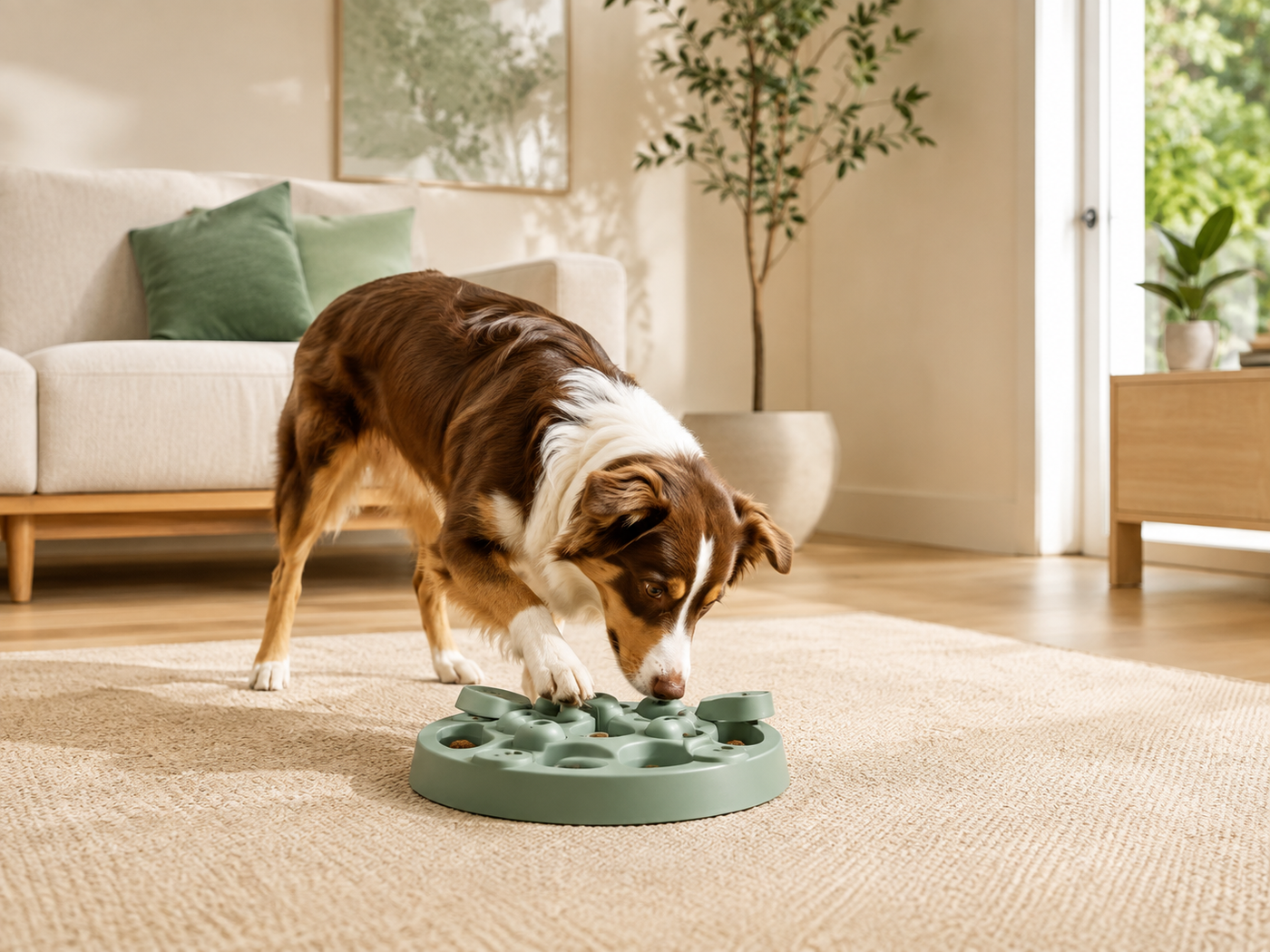
- Puzzle feeders. Mental work without physical space. The Quack & Snack for most dogs; the Clever Paws board for experienced problem-solvers.
- Hallway recall. A corridor is a perfectly good recall lane. Two people, short distance, generous rewards.
- Cardboard box demolition. Free. A clean box with kibble inside. Supervise closely and clear the debris — cardboard is not for eating.
- Trick training. Five minutes of hand targeting, spins or paw work costs nothing and tires a dog more than a walk of the same length.
- Balcony sniffing (safely). If your balcony is secure and enclosed, letting your dog sit and take in the smells and sounds of the street is genuine enrichment. Never leave a dog unattended on a balcony.
Managing noise — the real apartment constraint
- Use rugs. They cut the sound of rolling toys and claws on hard floors dramatically.
- Favour fabric over hard plastic for activities near shared walls.
- Time it sensibly. Rolling feeders at 6am will not endear you to anyone.
- Address barking at hallway noise as its own issue — more enrichment alone won't resolve reactivity to footsteps outside the door. That may need a qualified behaviour professional.
A realistic apartment day
Morning: breakfast through a slow feeder or rolling toy. Midday: snuffle mat if you're home, otherwise nothing — a missed session isn't a failure. Afternoon: a puzzle during the restless hour. Evening: lick mat, then settling practice on a mat while you cook.
Total hands-on time: under ten minutes. Full detail in enrichment for busy owners.
Storage in a small space
The main reason apartment routines fail is clutter. Keep two or three products in one tub near where you prepare food, and store the rest out of sight — which doubles as rotation, keeping novelty high. See how to create an enrichment station.
What enrichment won't fix
Enrichment doesn't replace walks, toilet breaks or company. It won't resolve separation-related distress, reactivity to hallway noise, or barking that's driven by anxiety. If your dog struggles when left alone, or reacts strongly to sounds outside the door, speak with a veterinarian and a qualified reward-based behaviour professional — apartment living makes those issues harder to live with, and they respond much better to early help.
Safety
- Select products appropriate for your dog's size, age and behaviour.
- Supervise initial use of anything new, and all DIY activities.
- Cardboard, towels and boxes are for shredding, not eating — clear debris promptly.
- Never leave a dog unattended on a balcony.
- Count enrichment food as part of the daily ration.
Frequently asked questions
Is an apartment fair on a dog?
Plenty of dogs live happily in apartments. What matters is daily outdoor time, mental stimulation and routine — not floor area. Some individual dogs and higher-energy types need considerably more outdoor time to be content.
How much space does a puzzle feeder need?
Very little. Most work in a square metre. Rolling toys need a bit more open floor, but a hallway is usually enough.
My neighbours complain about noise.
Switch to fabric-based activities — snuffle mats, lick mats, towel rolls — and add rugs. If the noise is barking rather than toys, that's a separate issue worth getting professional help with.
Can I do this in a rental?
All twelve activities are non-destructive and leave no marks. A feeding mat under activities protects carpet and helps at inspection time.
Does my dog still need walks?
Yes. Enrichment complements exercise, toileting and social contact — it doesn't substitute for any of them.
Not sure where to start? Find My Dog's Level takes about a minute.