By the Pawy Editorial Team · Last updated August 2026. This guide is educational and is not veterinary or behavioural advice.
The honest answer: your dog does not need an hour of your attention during the workday. They need three or four short, predictable moments spread across it. Most of those take under two minutes to set up and use food your dog was going to eat anyway. This guide maps them onto a real working day.
Why the workday is the hard part
Weekends are easy. Walks happen, people are home, the day has texture. Weekdays are when routines collapse — and a dog whose day contains nothing between breakfast and 6pm will find their own entertainment, usually in a form you'd rather they didn't.
The fix isn't more time. It's better placement of the time you already spend feeding them.
The core idea: feed through activities, not bowls
If your dog eats twice a day from a bowl, that's roughly forty seconds of engagement out of twenty-four hours. Route the same food through activities and it becomes thirty to sixty minutes — at no extra cost, no extra calories, and almost no extra time from you.
A realistic weekday
7:00am — before you leave
Breakfast through a slow feeder or a rolling toy instead of a bowl. A slow feeder bowl needs zero setup — tip the food in, put it down. A rolling treat dispenser adds movement and buys you the ten minutes you need to get out the door.
Setup time: under a minute.
Midday — if someone is home, or you're working from home
A short foraging session on a snuffle mat using a portion held back from breakfast. Sniffing is quiet, so it works during calls. If nobody is home, skip it — a missed midday session is not a failure.
Setup time: under a minute.
Late afternoon — the difficult hour
This is when most dogs get restless and most owners are least available. A staged puzzle like the Quack & Snack or, for experienced dogs, the Clever Paws board takes real mental effort and lands exactly where the gap is.
Setup time: two minutes.
Evening — wind-down
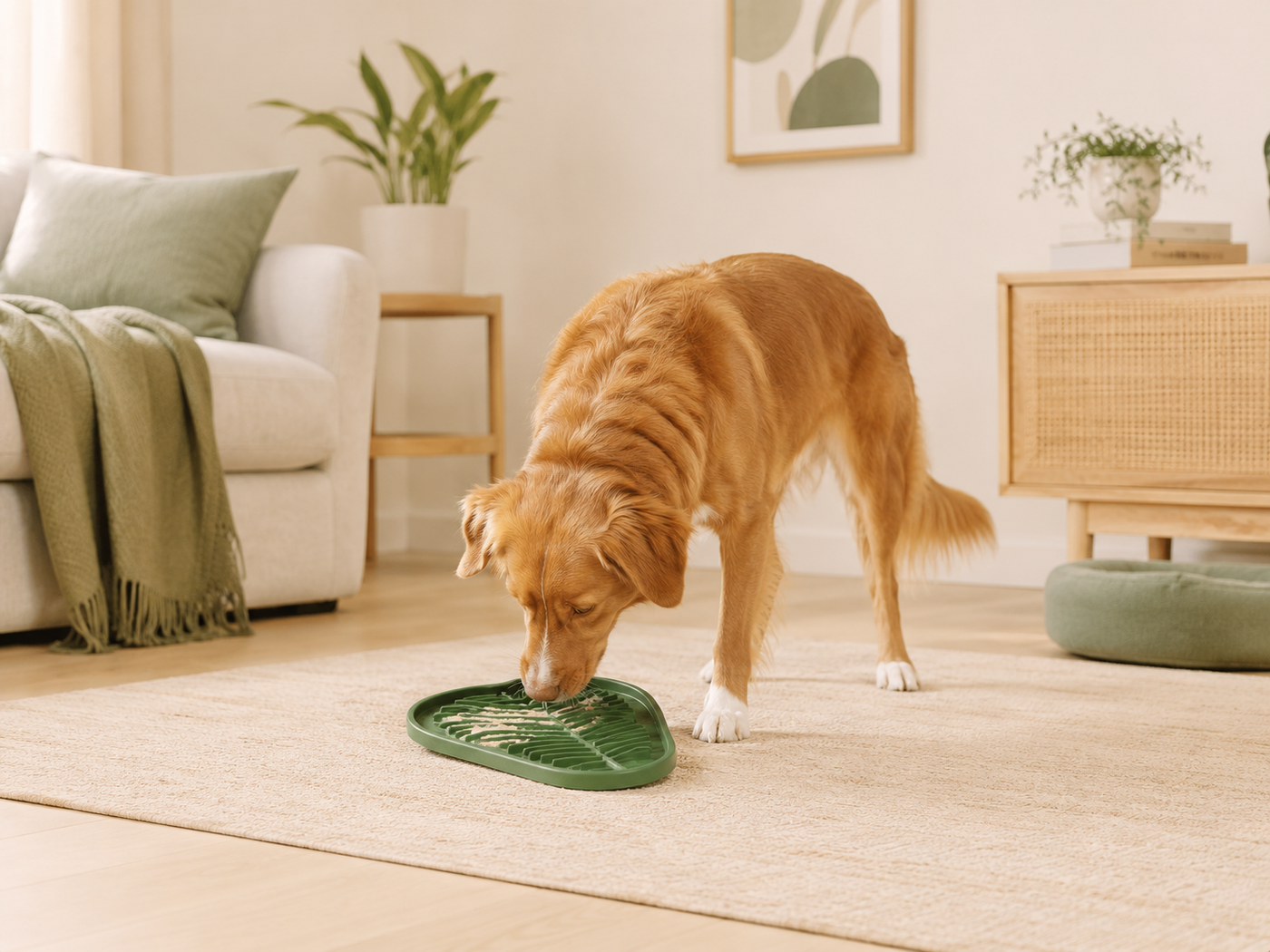
A lick mat with a thin layer of dog-appropriate soft food. Licking is slow, repetitive and stationary, which suits the end of the day. Freeze it if the product's care instructions allow and the session stretches considerably.
Setup time: two minutes, or thirty seconds if you prepared it the night before.
Working from home changes the problem
Working from home doesn't automatically solve enrichment — it often makes it worse, because your dog gets used to constant proximity and then struggles the moment you leave.
Two things help. First, run enrichment sessions in a different room from where you work, so your dog learns to disengage from you. Second, practise short, boring departures — keys, shoes, door, back in ninety seconds — so leaving stops predicting a long absence. Our Calm Home Routine covers this properly, and the 30-Day Puppy Blueprint builds alone-time foundations on Day 21.
What to buy if you're starting from nothing
You do not need six products. Start with two that cover opposite ends of the day:
- One active option — a rolling feeder or slow feeder for the morning.
- One calm option — a lick mat or snuffle mat for the evening.
Add a third only when those two are genuinely part of your routine. Browse Workday Enrichment, or let Find My Dog's Level narrow it down.
Making it stick
- Prepare the night before. A loaded lick mat in the freezer removes the main excuse.
- Keep everything in one place. If setup means opening three cupboards, it won't happen on a busy Tuesday. See how to create an enrichment station.
- Rotate, don't accumulate. Two or three products swapped across the week beat a cupboard of ignored ones.
- Accept missed days. A routine that survives a bad week is better than a perfect one that collapses.
What enrichment will not do
It will not replace exercise, companionship, training or veterinary care. It will not resolve separation-related distress, and it is not a treatment for anxiety or any behavioural condition. If your dog shows persistent distress when alone — escalating vocalisation, destruction at exits, house-soiling in an otherwise reliable dog — that needs a veterinarian and a qualified behaviour professional, and it responds far better to early help.
Safety
- Select products appropriate for your dog's size, age and behaviour.
- Supervise initial use of anything new; inspect regularly and remove if damaged.
- Feeding products are not chew toys.
- Count enrichment food as part of the daily ration, not on top of it.
Frequently asked questions
How long should each session last?
There's no single correct answer — it depends on the dog, the product and the food. A good session ends while your dog is still interested rather than after they've walked away.
Is it safe to leave enrichment products with a dog who's alone?
Only once you know how your dog handles that specific product, and only for products without small parts. Supervise first, every time.
My dog loses interest after a few days. What am I doing wrong?
Almost always novelty, not the product. Rotate activity types across the week rather than repeating the same one daily.
Can I use this with a puppy?
Yes, with beginner-level products, supervision and shorter sessions. Puppies also need considerably more sleep than most owners expect — an over-tired puppy looks like a bored one.
Do I need to buy anything to start?
No. Scatter-feeding dry food across a clean floor or a towel is genuine foraging enrichment and costs nothing. Products make it tidier, longer-lasting and easier to repeat — but the principle works without them.