By the Pawy Editorial Team · Last updated August 2026. This guide is educational and is not veterinary or behavioural advice.
Short answer: a snuffle mat is the better first purchase for most dogs, and a puzzle feeder is the better second one. Snuffle mats work immediately with no learning curve, suit nervous and senior dogs, and are near-silent. Puzzle feeders take longer, work the brain harder, and can frustrate a dog who has never solved anything for food before. If you're choosing one to start with, start with the mat.
The quick comparison
| Snuffle mat | Puzzle feeder | |
|---|---|---|
| Learning curve | None — most dogs get it in seconds | Real — needs introduction and supervision |
| Typical session | 5–15 minutes | 2–20 minutes depending on difficulty |
| Noise | Silent | Can be loud on hard floors |
| Food type | Dry food, small treats | Dry food, small treats |
| Best for | Calm sessions, nervous dogs, apartments, seniors | Confident dogs who need a mental workout |
| Cleaning | Shake out, wash periodically | Rinse after each use |
| Frustration risk | Very low | Moderate if introduced too hard |
What a snuffle mat actually does
A snuffle mat is fabric with dense folds. You scatter dry food into it and your dog finds the food by scent. That's the whole mechanism — and its simplicity is the point.
Sniffing is genuinely absorbing work for a dog. A mat turns a handful of kibble that would disappear in twenty seconds into a slow, methodical search. Because there's nothing to solve, there's almost nothing to get wrong: a dog who has never used an enrichment product in their life will usually start working a mat within a few seconds of it hitting the floor.
That makes it the safest starting point for a nervous dog, a rescue still settling in, a senior whose joints don't love standing puzzles, or an apartment where a rolling toy at 7am would be unwelcome. See the Sniff & Seek Snuffle Mat or browse all sniffing and foraging products.
What a puzzle feeder actually does
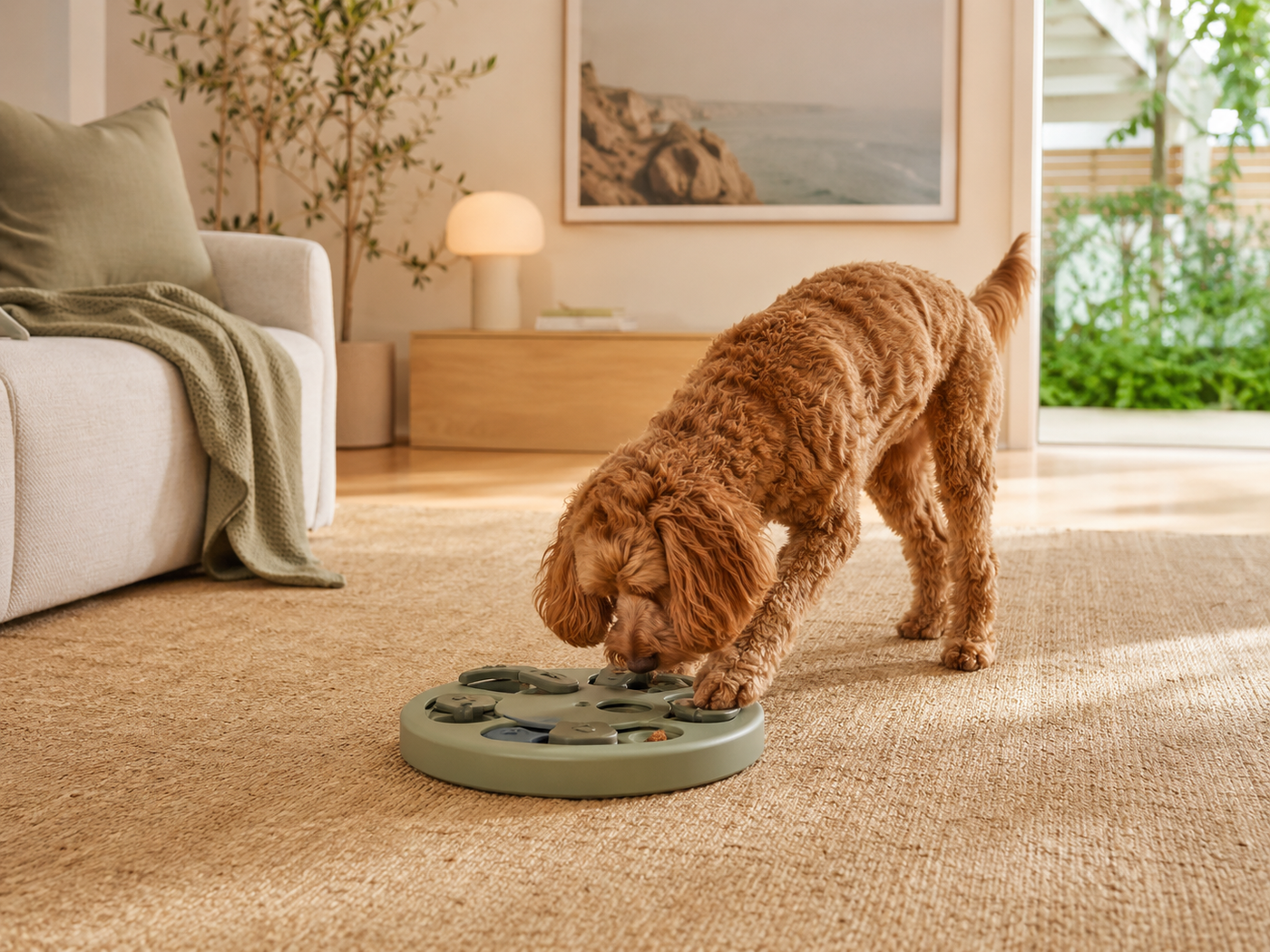
A puzzle feeder asks your dog to perform an action — nudge, roll, lift, slide, rotate — before food is released. The reward is contingent on solving something, which is a genuinely different cognitive task from searching.
That difference is why puzzles keep working when mats start to feel routine, and also why they carry a frustration risk. A dog who paws at a board for ninety seconds without a single piece of food coming loose learns that the board isn't worth bothering with. That impression is much harder to undo than it is to avoid.
This is why Pawy grades puzzles by difficulty rather than selling them as one category. The Treat Trail rolling ball and Workday Wobble treat dispenser release food generously — beginner territory. The Quack & Snack puzzle adds staged release. The Clever Paws board is multi-step and suits only dogs with real puzzle experience.
Which should you buy first?
Choose the snuffle mat if…
- Your dog has never used an enrichment product before
- They're nervous, newly adopted, or still settling into your home
- You live in an apartment or share walls
- You want something for evenings and wind-down time
- Your dog is a senior, or has any mobility limitation
- You want the lowest possible chance of frustration
Choose the puzzle feeder if…
- Your dog empties a food bowl and immediately looks for the next thing
- They already work a mat confidently
- You're specifically after mental tiring rather than calm
- You can supervise the first several sessions
- Hard flooring is available for rolling designs
Why most owners end up with both
They do different jobs at different times of day. Sniffing suits the afternoon lull and the evening wind-down. Puzzling suits the morning, when your dog has energy to burn and you have a meeting to get to.
Rotation is what keeps either one interesting. Using the same product every single day is the fastest way to make a dog stop caring about it — see our guide to rotating enrichment products, and the seven-day routine that spreads activity types across the week.
Introducing either one
- Use a normal mealtime. A hungry dog is a motivated dog, and using part of the daily ration means you're not adding calories.
- Make the first attempt too easy. Food visible on top of the mat; puzzle compartments left open.
- Say nothing and step back. Let your dog work it out. Interrupting to help teaches them to wait for you.
- Stop while they're still interested, not after they've given up.
- Increase difficulty only when the current level looks effortless.
Safety
- Select a product appropriate for your dog's size, age and behaviour.
- Supervise initial use, inspect regularly and remove anything damaged.
- Both are feeding tools, not chew toys — supervise dogs who chew fabric, as loose material is a swallowing risk.
- Count enrichment food as part of the daily ration.
Frequently asked questions
Can I use a snuffle mat and a puzzle feeder on the same day?
Yes. Many owners run a puzzle in the morning and a mat in the evening. Just count all of it as part of the daily food ration rather than in addition to it.
My dog finishes the snuffle mat in one minute. Is it working?
Probably it's too easy. Push the food deeper into the folds, use smaller pieces, and try a mat with denser fabric. If it's still quick, that's the signal your dog is ready for a puzzle.
Are puzzle feeders suitable for puppies?
Beginner-level ones, yes, with supervision and realistic expectations. Start with generous food release. Our 30-Day Puppy Training Blueprint introduces food enrichment on Day 24, after the foundations are in place.
Which is better for a dog left alone during the day?
Neither should be left with an unsupervised dog until you know exactly how they handle it. Once you do, a snuffle mat is usually the safer unsupervised option because there are no small parts — but supervise first, always.
Do snuffle mats help with anxiety?
Sniffing is naturally absorbing and many owners find their dog settles more easily afterwards. But enrichment is not a treatment for anxiety. If your dog shows persistent distress, speak with a veterinarian or a qualified behaviour professional.
Not sure which level suits your dog? Find My Dog's Level asks eight questions and recommends a starting point.