By the Pawy Editorial Team · Last updated August 2026. Educational information only — not veterinary or behavioural advice.
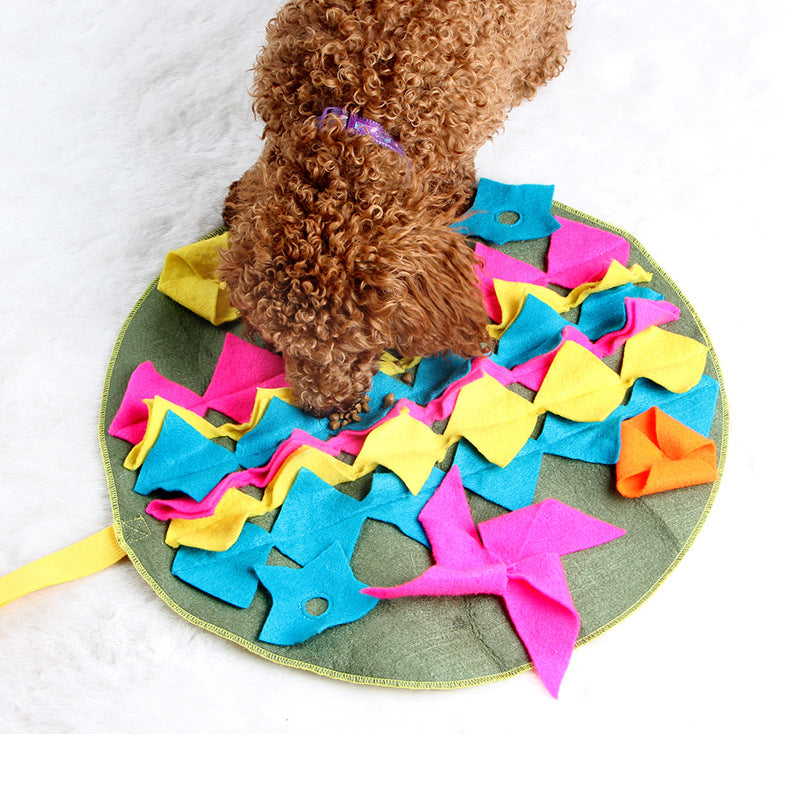
Introduce a snuffle mat by making the first session almost too easy: scatter food on top of the folds, put the mat down, and say nothing. Most puppies start working it within seconds. The mistake that causes problems is hiding food deep on the very first attempt — a puppy who finds nothing in the first thirty seconds usually walks away, and rebuilding that interest takes far longer than starting easy would have.
Why snuffle mats suit puppies so well
Sniffing is one of the first things a puppy is genuinely good at. They don't need to learn it, they don't need coordination for it, and it doesn't require the impulse control that puzzle feeders demand. That makes a snuffle mat one of the safest first enrichment products for a young dog.
It's also quiet and stationary, which matters more than owners expect. A puppy who has been racing around all afternoon often needs a calm activity, not another exciting one.
Before the first session
- Use part of a normal meal. A slightly hungry puppy engages faster, and you're not adding extra food to the day.
- Pick a quiet space with no other dogs, no children rushing past and nothing else happening.
- Have the mat flat on a non-slip surface.
- Plan to supervise the entire session. Every session, not just the first.
The five-step introduction
- Let them investigate the empty mat. Ten seconds is plenty. Curiosity about the object comes before curiosity about the food.
- Scatter food on top. Visible, easy, no hiding at all. Your puppy should succeed immediately.
- Step back and stay quiet. Don't point, don't guide their nose, don't say "find it" over and over. Interrupting teaches them to look at you instead of the mat.
- Once they clear the top easily — usually the second or third session — tuck a few pieces just into the folds.
- Increase gradually across days, not within one session. Deeper, then denser, then a fuller portion.
How long should a session last?
There's no fixed number, and any guide that gives you one is guessing about your puppy. What matters is where you stop: end while your puppy is still interested rather than after they've drifted off. A short successful session builds enthusiasm; a long one that ends in boredom teaches the opposite.
Common problems
They ignore it completely. Too hard, or not hungry. Scatter more food, more visibly, at a mealtime.
They finish it in twenty seconds. That's a good problem. Push food deeper and use smaller pieces.
They pick the mat up and shake it. Normal puppy behaviour, but it's your cue to supervise closely — and to end the session. A mat is a feeding tool, not a tug toy.
They chew the fabric. Take it away immediately. Loose fabric is a swallowing risk, and a dog who chews mats needs a different product category.
They get frustrated and bark at it. Make it dramatically easier and rebuild. Frustration at this stage is always a setup problem, never a character flaw.
Cleaning and care
Shake out loose food after every session. Wash regularly following the care label supplied with the product, and dry thoroughly before storing — a damp mat stored rolled up will not stay pleasant. Retire any mat that becomes torn or frayed.
Safety
- Select a product appropriate for your puppy's size, age and behaviour.
- Supervise every session while your puppy is young.
- Inspect the mat regularly and remove it if damaged.
- Count the food used as part of the daily ration rather than in addition to it.
- Enrichment does not replace exercise, training, companionship or veterinary care.
What comes next
Once a snuffle mat is routine, most puppies are ready for a beginner rolling feeder or a lick mat for evenings. Browse sniffing and foraging products, see the Sniff & Seek mat, or compare options in snuffle mat vs puzzle feeder. Our 30-Day Puppy Training Blueprint introduces food enrichment on Day 24, once the foundations are in place.
Frequently asked questions
What age can a puppy start using a snuffle mat?
Once they're eating solid food confidently and you can supervise closely, a mat is generally suitable. Start with very easy setups and short sessions, and check with your vet if you have any concerns about your individual puppy.
Can I use treats instead of kibble?
Yes, though ordinary dry food works well and keeps the daily ration in check. Whatever you use, count it as part of the day's food.
Can I leave my puppy alone with a snuffle mat?
Not while they're young and not until you know exactly how they treat it. Puppies mouth and chew fabric, and that's a supervision matter.
My puppy prefers the mat to their bowl. Is that a problem?
Not at all — many owners feed part of every meal this way. Just keep an ordinary bowl available for days when a slower meal doesn't suit.
How often can I use it?
Daily is fine. Rotating with other activity types keeps interest higher than repeating the same one every day.