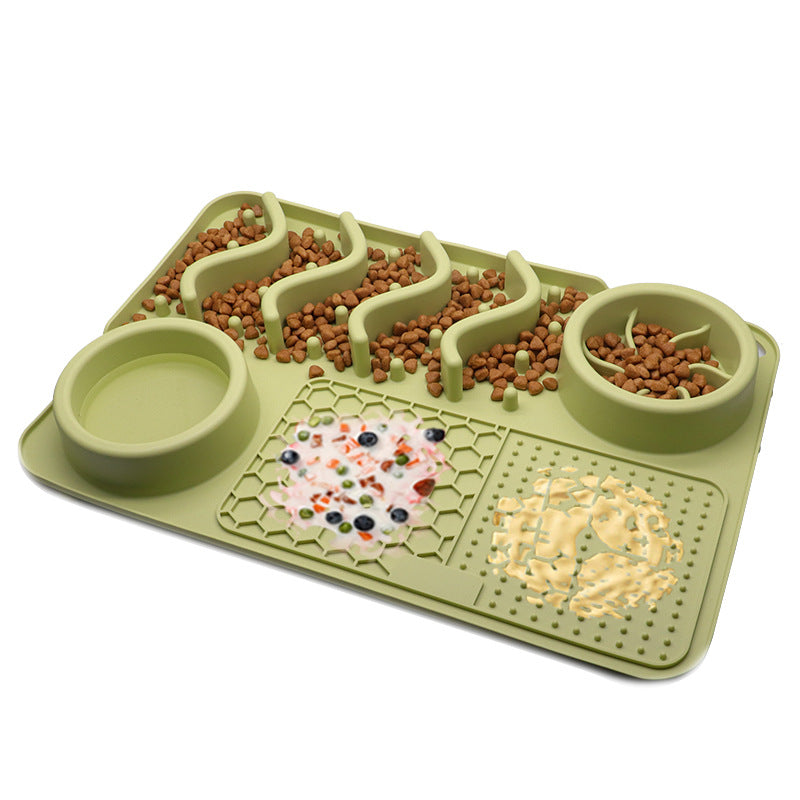
By the Pawy Editorial Team · Last updated August 2026. Educational information only — not veterinary or nutritional advice. Check anything new with your vet if your dog has dietary restrictions or health conditions.
The short answer: thin layers of soft, dog-appropriate food. Plain natural yoghurt, wet dog food, mashed pumpkin or sweet potato, mashed banana, and dog-safe peanut butter are the common choices. What matters more than the topping is the amount — a lick mat is a way of slowing food down, not a way of adding extra food to the day.
The one rule that matters
Spread it thin. The texture does the work, not the quantity. A thick layer gets cleared in two minutes and adds calories your dog didn't need. A thin layer worked into the grooves can last ten to twenty minutes, longer if frozen.
Count whatever you use as part of the daily food ration. If you're topping a mat every evening with a generous scoop of something rich, that adds up faster than most owners expect.
Commonly used toppings
Everyday options
- Wet dog food — the simplest choice. Already formulated for dogs, already portioned.
- Plain natural yoghurt — unsweetened, no added flavourings. Some dogs don't tolerate dairy well, so start very small.
- Mashed pumpkin or sweet potato — plain, cooked, nothing added.
- Mashed banana — small amounts; it's high in sugar.
- Dog-safe peanut butter — see the critical warning below.
- Soaked kibble — your dog's normal food, softened with water into a paste. Free, and it uses food they were already getting.
For variety
- Plain cottage cheese, in small amounts
- Unsweetened apple purée
- Bone broth (no onion, no garlic, no added salt) — thin, so freeze it
- Blended dog-safe vegetables
⚠️ Never use these
This list matters more than the ideas above.
- Anything containing xylitol (also labelled birch sugar). This is the big one — it is highly toxic to dogs and appears in many "no added sugar" and "low sugar" peanut butters. Read the label every single time, including on brands you have used before, because recipes change.
- Chocolate, cocoa, coffee
- Grapes, raisins, sultanas — including anything containing them
- Onion, garlic, leek, chives — including cooked, powdered and in stocks
- Macadamias and most nuts
- Alcohol, or anything containing it
- Salty, heavily processed or spiced human food
- Cooked bones or anything with bone fragments
If your dog eats something on this list, contact your veterinarian or an animal poisons line straight away rather than waiting to see what happens.
Freezing
Freezing a loaded mat turns a five-minute activity into a much longer one, and suits warm Australian afternoons. Load it, spread thin, freeze flat for a few hours.
Two cautions: check the mat's own care instructions allow freezing, and go gently with dogs who have sensitive teeth or are very young. A rock-hard frozen mat is harder work than some dogs want.
How often, and how much
Daily is fine if the portions are part of the normal ration rather than on top of it. Many owners use a lick mat as the evening wind-down and route breakfast through a slow feeder or rolling feeder instead — that way the day has variety and the food budget doesn't change.
If your dog is on a weight management plan, prescription diet, or has any digestive sensitivity, talk to your vet before introducing new toppings.
Cleaning
Wash with warm water and mild detergent after every use, and dry thoroughly before storing. Dried-on food in the grooves is the main reason mats get retired early. Inspect the surface regularly and replace the mat if it becomes torn — see the Settle & Lick Activity Mat care guidance.
Safety
- Select a mat appropriate for your dog's size, age and behaviour.
- Supervise initial use, and any dog who chews rather than licks.
- A lick mat is a feeding tool, not a chew toy. Remove it if damaged.
- Introduce new foods one at a time and in small amounts.
- Enrichment does not replace exercise, training, companionship or veterinary care.
Frequently asked questions
Is peanut butter safe for dogs?
Plain peanut butter with no xylitol and no added salt or sugar is commonly used. The danger is xylitol, which is toxic to dogs and appears in some sugar-free varieties. Check the ingredients list every time — brands reformulate without warning.
How long should a lick mat session last?
There's no universal answer. Ten to twenty minutes is typical with a thin frozen layer. End the session when the mat is finished or your dog loses interest, whichever comes first.
Can puppies use lick mats?
Yes, with supervision, small portions and softer (unfrozen) toppings at first. Our 30-Day Puppy Training Blueprint introduces food enrichment on Day 24.
My dog chews the mat instead of licking it.
Take it away and supervise more closely next time. Some dogs chew because the topping is gone; others because chewing is their default. If it persists, a lick mat may not be the right product for that dog.
Can I leave my dog alone with a lick mat?
Only once you know exactly how your dog treats it, and never with a puppy. Supervise first, always.
Does licking calm dogs down?
Many owners find their dog settles more easily after a licking session, and it's a common part of a wind-down routine. But it isn't a treatment for anxiety — persistent distress needs a veterinarian or qualified behaviour professional.
Browse Licking & Settling, or compare activity types in snuffle mat vs puzzle feeder.